Yale’s digital humanities project Robots Reading Vogue explores questions in two academic fields: gender studies and computer science, more specifically data mining and fashion, using all Vogue magazines published in the last 128 years.
Sources
The project’s primary source is Vogue Archive, which contains high-resolution color page images of all the US edition Vogue magazines from 1892 to the present day. Those more than 400,000 pages, 2,700 covers, and 6TB of data were used to answer research questions in computer science and gender studies, exploring topics as modeling, n-grams, and color analysis.
Unfortunately, Vogue Archive data is not available for broader use; the archive is owned by ProQuest and Condé Nast and it requires an access license.
Processes
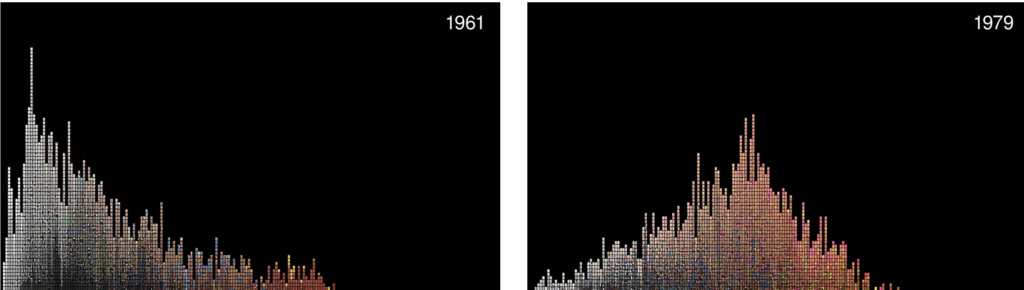
The specific processes vary widely by experiment and can range from image overlaying and alignment (Averaging Covers in Vogue) to data processing, analysis, and visualization (Advertisements in Vogue). An interesting experiment to explore processes is Slice Histograms, which offers direct visualization of color patterns. In this experiment, all the images in the data set were sliced into a uniform number of pieces, and 2,500 random slices per year were selected and then individually graphed into a histogram. The slices were organized by saturation on the X-axis and brightness on the Y-axis. Finally, the researchers labeled each frame with the year it represented using Imagemagick and then combined the frames into a movie using the ffmpeg video encoder.
Presentation
The project’s website made several different experiments accessible, each containing its own page, images, information, and experiment conclusions. One example is Averaging Covers in Vogue that tracks visual continuity and change across the decades in the covers by overlaying each of the covers for a given year and therefore generate a mean RGB value for each pixel. Below is a “decennial sampling” of the magazine’s cover from 1900 to 2000.

Finally, Robots Reading Vogue is a fascinating digital humanities project, that combines cutting edge technology to detailed humanistic interpretations of data and facts.


I was also really interested in this project so I’m glad someone chose to explore it further. The Averaging Covers in Vogue experiment sounds really fun and I’d be interested to learn more about how such data can have broader relevance to the field of DH
Luisa, this post is really interesting! I found the Sliced Histogram experiment you mentioned in the Processes section really interesting–it looks like brightness was more of a focus in the earlier year, while saturation was preferred over brightness in 1979. I’d be interested to learn about the significance of this and maybe the meaning behind the change from brightness to saturation.