
Stanford University’s Mapping the Republic of Letters is a project that maps the lines of communication between academics in the past using network visualization. The goal of the project is to establish relationships between academics. Another goal of this project is to compile a repository for metadata about academics. It is a collaboration between the Stanford Humanities Center, University of Oxford, the Groupe D’Alembert of the French CNRS, Huygens ING’s CKCC, and the DensityDesign Research Lab.
In creating visualizations, the project uses correspondence metadata from various sources and creates network charts based on this information. There are many example cases on its website to show how it works, with one of the case studies being an analysis of French author Voltaire’s correspondences. On these networks, the nodes are the correspondents, the writer and the recipient. These nodes can be superimposed over maps to show the correspondents’ nationality, as in figure 1, but also grouped based on their mutual contacts, as in figure 2.
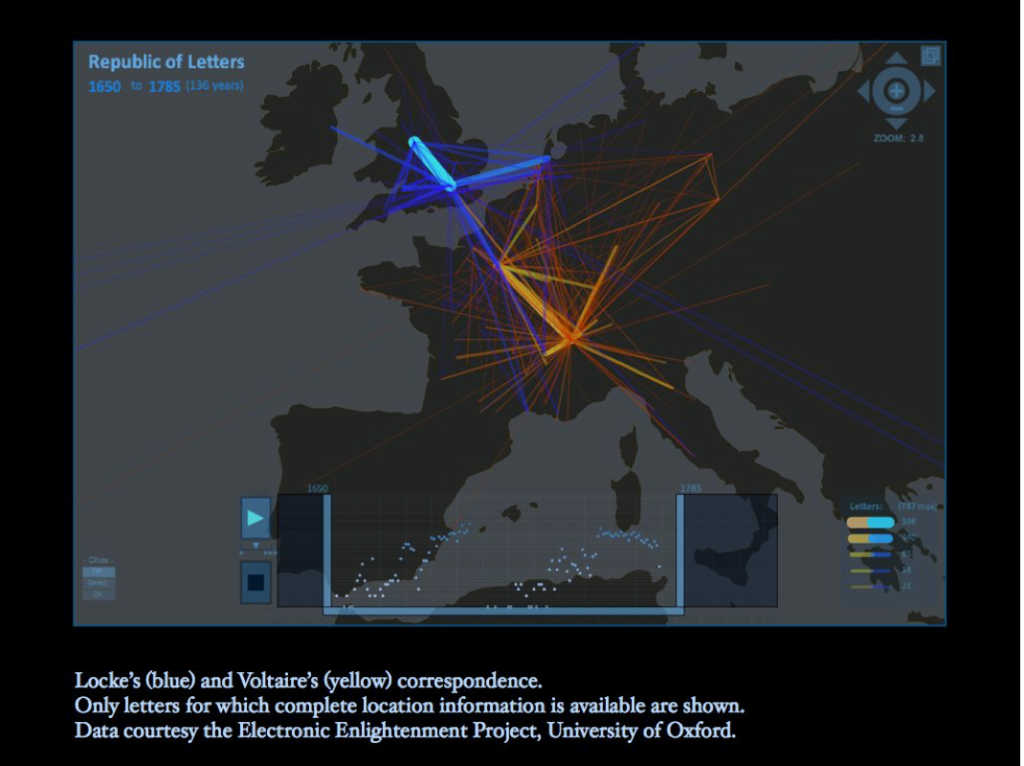
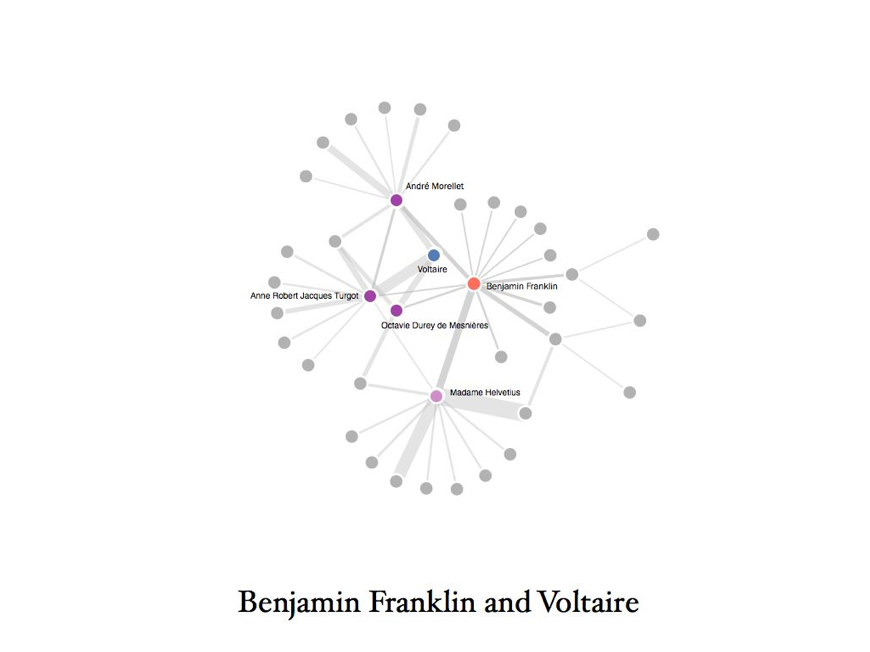
The network’s edges are the number of letters sent, with the most letters sent being given a thicker connection line than the line for fewer letters. This differentiation allows the reader to understand the relative strength of the relationship between the writer and the recipient. Using this tool, one can also add metadata, such as demographics, about recipients and writers. This technology is very useful when categorizing and organizing relationships by the parties’ various demographics.
This technology has many implications. The technology can make connections between correspondents, showing how much correspondence there was, and one can use this to judge the strength of the relationship between the two. In modern times, this could be used to analyze the communications between workers or email chains between people. Also, with the addition of metadata specific to each correspondent’s demographics, one can infer relationships globally in the recipient’s metadata.


Hey Phoebe,
I think that the project you analyzed is interesting as it shows trends of what parts of this area are more connected than the others. It is a bit confusing upon first glance and I think that some labels signifying the country of origin would be helpful. I also would be interested on finding out if the letter writing is more one-sided or if there is equal correspondence in both directions.
Hello Phoebe! I like how you discussed the significance of edges’ thickness in terms of relationships between writers and recipients. I wonder what sources the project used and if there was a bias toward texts written in English.
Phoebe, this is a super interesting project and I can see many uses for it. One thing I was wondering is how this project might be completed in the digital age, where correspondance is so frequent and easy? How might digital social networks be mapped?